✍️ Note
All the codes and contents are sourced from Apple’s official documentation. This post is for personal notes where I summarize the original contents to grasp the key concepts
What is Concurrency Programming?
Concurrency is the notion of multiple things happening at the same time. Although operating systems like OS X and iOS are capable of running multiple programs in parallel, most of those programs run in the background and perform tasks that require little continuous processor time. It is the current foreground application that both captures the user’s attention and keeps the computer busy. If an application has a lot of work to do but keeps only a fraction of the available cores occupied, those extra processing resources are wasted.
Both OS X and iOS adopt a more asynchronous approach to the execution of concurrent tasks than is traditionally found in thread-based systems and applications.
https://developer.apple.com/library/archive/documentation/General/Conceptual/ConcurrencyProgrammingGuide/Introduction/Introduction.html#//apple_ref/doc/uid/TP40008091-CH1-SW1
Terms
- The term thread is used to refer to a separate path of execution for code. The underlying implementation for threads in OS X is based on the POSIX threads API.
- The term process is used to refer to a running executable, which can encompass multiple threads.
- The term task is used to refer to the abstract concept of work that needs to be performed.
Concurrency and Application design
Although threads have been around for many years and continue to have their uses, they do not solve the general problem of executing multiple tasks in a scalable way. With threads, the burden of creating a scalable solution rests squarely on the shoulders of you, the developer. You have to decide how many threads to create and adjust that number dynamically as system conditions change. Another problem is that your application assumes most of the costs associated with creating and maintaining any threads it uses.
Instead of relying on threads, OS X and iOS take an asynchronous design approach to solving the concurrency problem. Asynchronous functions have been present in operating systems for many years and are often used to initiate tasks that might take a long time, such as reading data from the disk. When called, an asynchronous function does some work behind the scenes to start a task running but returns before that task might actually be complete. Typically, this work involves acquiring a background thread, starting the desired task on that thread, and then sending a notification to the caller (usually through a callback function) when the task is done. In the past, if an asynchronous function did not exist for what you want to do, you would have to write your own asynchronous function and create your own threads. But now, OS X and iOS provide technologies to allow you to perform any task asynchronously without having to manage the threads yourself.
https://developer.apple.com/library/archive/documentation/General/Conceptual/ConcurrencyProgrammingGuide/ConcurrencyandApplicationDesign/ConcurrencyandApplicationDesign.html#//apple_ref/doc/uid/TP40008091-CH100-SW1
Grand Central Dispatch
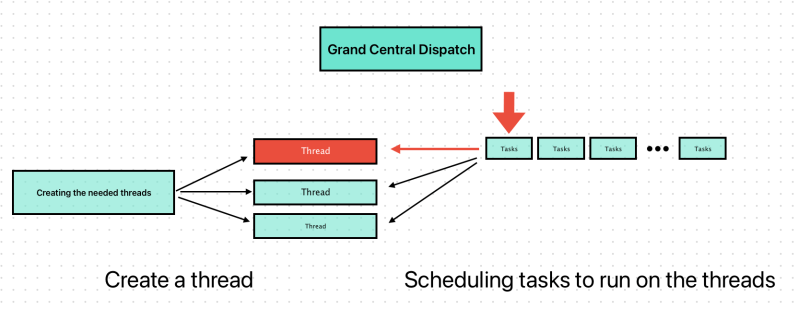
One of the technologies for starting tasks asynchronously is Grand Central Dispatch (GCD). This technology takes the thread management code you would normally write in your own applications and moves that code down to the system level. All you have to do is define the tasks you want to execute and add them to an appropriate dispatch queue. GCD takes care of creating the needed threads and of scheduling your tasks to run on those threads. Because the thread management is now part of the system, GCD provides a holistic approach to task management and execution, providing better efficiency than traditional threads.
Apple
OperationQueue
Operation queues are Objective-C objects that act very much like dispatch queues. You define the tasks you want to execute and then add them to an operation queue, which handles the scheduling and execution of those tasks. Like GCD, operation queues handle all of the thread management for you, ensuring that tasks are executed as quickly and as efficiently as possible on the system.
An operation queue is the Cocoa equivalent of a concurrent dispatch queue and is implemented by the
NSOperationQueueclass. Whereas dispatch queues always execute tasks in first-in, first-out order, operation queues take other factors into account when determining the execution order of tasks. Primary among these factors is whether a given task depends on the completion of other tasks. You configure dependencies when defining your tasks and can use them to create complex execution-order graphs for your tasks.The tasks you submit to an operation queue must be instances of the
NSOperationclass. An operation object is an Objective-C object that encapsulates the work you want to perform and any data needed to perform it. Because theNSOperationclass is essentially an abstract base class, you typically define custom subclasses to perform your tasks. However, the Foundation framework does include some concrete subclasses that you can create and use as is to perform tasks.Operation objects generate key-value observing (KVO) notifications, which can be a useful way of monitoring the progress of your task. Although operation queues always execute operations concurrently, you can use dependencies to ensure they are executed serially when needed.
For more information about how to use operation queues, and how to define custom operation objects, see Operation Queues.
Apple
DispatchQueue
Dispatch queues are a C-based mechanism for executing custom tasks. A dispatch queue executes tasks either serially or concurrently but always in a first-in, first-out order. (In other words, a dispatch queue always dequeues and starts tasks in the same order in which they were added to the queue.) A serial dispatch queue runs only one task at a time, waiting until that task is complete before dequeuing and starting a new one. By contrast, a concurrent dispatch queue starts as many tasks as it can without waiting for already started tasks to finish.
Dispatch queues have other benefits:
- They provide a straightforward and simple programming interface.
- They offer automatic and holistic thread pool management.
- They provide the speed of tuned assembly.
- They are much more memory efficient (because thread stacks do not linger in application memory).
- They do not trap to the kernel under load.
- The asynchronous dispatching of tasks to a dispatch queue cannot deadlock the queue.
- They scale gracefully under contention.
- Serial dispatch queues offer a more efficient alternative to locks and other synchronization primitives.
The tasks you submit to a dispatch queue must be encapsulated inside either a function or a block object. Block objects are a C language feature introduced in OS X v10.6 and iOS 4.0 that are similar to function pointers conceptually, but have some additional benefits. Instead of defining blocks in their own lexical scope, you typically define blocks inside another function or method so that they can access other variables from that function or method. Blocks can also be moved out of their original scope and copied onto the heap, which is what happens when you submit them to a dispatch queue. All of these semantics make it possible to implement very dynamic tasks with relatively little code.
Dispatch queues are part of the Grand Central Dispatch technology and are part of the C runtime. For more information about using dispatch queues in your applications, see Dispatch Queues. For more information about blocks and their benefits, see Blocks Programming Topics.
Apple
Dispatch Sources
Dispatch sources are a C-based mechanism for processing specific types of system events asynchronously. A dispatch source encapsulates information about a particular type of system event and submits a specific block object or function to a dispatch queue whenever that event occurs. You can use dispatch sources to monitor the following types of system events:
- Timers
- Signal handlers
- Descriptor-related events
- Process-related events
- Mach port events
- Custom events that you trigger
Dispatch sources are part of the Grand Central Dispatch technology. For information about using dispatch sources to receive events in your application, see Dispatch Sources.
Apple
Asynchronous Design Techniques
Concurrency can improve the responsiveness of your code by ensuring that your main thread is free to respond to user events. It can even improve the efficiency of your code by leveraging more cores to do more work in the same amount of time. However, it also adds overhead and increases the overall complexity of your code, making it harder to write and debug your code.
If you implemented your tasks using blocks, you can add your blocks to either a serial or concurrent dispatch queue. If a specific order is required, you would always add your blocks to a serial dispatch queue. If a specific order is not required, you can add the blocks to a concurrent dispatch queue or add them to several different dispatch queues, depending on your needs.
If you implemented your tasks using operation objects, the choice of queue is often less interesting than the configuration of your objects. To perform operation objects serially, you must configure dependencies between the related objects. Dependencies prevent one operation from executing until the objects on which it depends have finished their work.
Apple
Tips for Improving Efficiency
Consider computing values directly within your task if memory usage is a factor.
If your application is already memory bound, computing values directly now may be faster than loading cached values from main memory. Computing values directly uses the registers and caches of the given processor core, which are much faster than main memory. Of course, you should only do this if testing indicates this is a performance win.
Identify serial tasks early and do what you can to make them more concurrent
If a task must be executed serially because it relies on some shared resource, consider changing your architecture to remove that shared resource. You might consider making copies of the resource for each client that needs one or eliminate the resource altogether.
Avoid using locks
The support provided by dispatch queues and operation queues makes locks unnecessary in most situations. Instead of using locks to protect some shared resource, designate a serial queue (or use operation object dependencies) to execute tasks in the correct order.
Rely on the system frameworks whenever possible
The best way to achieve concurrency is to take advantage of the built-in concurrency provided by the system frameworks. Many frameworks use threads and other technologies internally to implement concurrent behaviors. When defining your tasks, look to see if an existing framework defines a function or method that does exactly what you want and does so concurrently. Using that API may save you effort and is more likely to give you the maximum concurrency possible.
 Shawn
Shawn 
Leave a comment